Back Pain: The Complete Patient Guide
Most back pain settles within six weeks on its own, and most of it has nothing to do with a disc. This is the framework I use in clinic. Where it hurts, what the pain feels like, how long it has lasted, and what each of those three things actually tells you.
In a typical clinic week I will see around thirty people with back pain, and I would guess twenty five of them arrive having already decided what is wrong. Usually they have decided it is a disc. Sometimes a relative has told them it sounds like sciatica. Sometimes a long search at eleven at night has told them something a great deal worse. Almost nobody arrives with no theory at all.
I understand why. Back pain frightens people in a way that a sore shoulder never does, because the spine feels structural, like the thing holding the whole operation up. But the theory people walk in with is wrong far more often than it is right, and the fear attached to it is nearly always out of proportion to what is actually happening. So this is my attempt to write down the same framework I would draw for you across a desk, so you can work out what is likely, what is unlikely, and what genuinely needs looking at.
Start with the part nobody tells you
Most back pain gets better on its own. Somewhere around nine in ten episodes of sudden lower back pain settle substantially within six weeks without any injection, any operation, and often without any treatment at all beyond staying reasonably active and giving it time. That is not me being breezy about your pain. It is the single most useful fact about backs that exists, and almost nobody hears it before they start searching.
The second thing worth knowing is that most back pain is not a disc. The great majority of what I see is coming from muscles, ligaments, and the small facet joints at the back of the spine, all of which are perfectly capable of producing severe pain without anything being torn, prolapsed or permanently damaged. A back can hurt enormously and still be structurally sound. Pain is a poor guide to seriousness in the spine, which is exactly why people get so frightened by it.
Here is the example I use most often. If I took a hundred people in their forties who have never had a single day of back pain in their lives and put every one of them through an MRI scanner, I would find disc bulges in a sizeable proportion of them and age related wear in most. They have no symptoms whatsoever. They will never know. The finding on the scan and the pain in the room are two separate questions, and conflating them causes a great deal of unnecessary worry. If you want the underlying mechanics of why, I wrote about how the spine actually works in more detail.
None of that means you should ignore it. Back pain is worth understanding properly, because the pattern of it tells you a great deal. I work through three questions with every new patient, in this order. Where is it. What does it feel like. How long has it been there.
Question one: where exactly does it hurt?
Patients tend to say “my back” and gesture vaguely at the whole of it. The specific location matters more than almost anything else, so it is worth being precise with yourself before you are precise with a doctor.
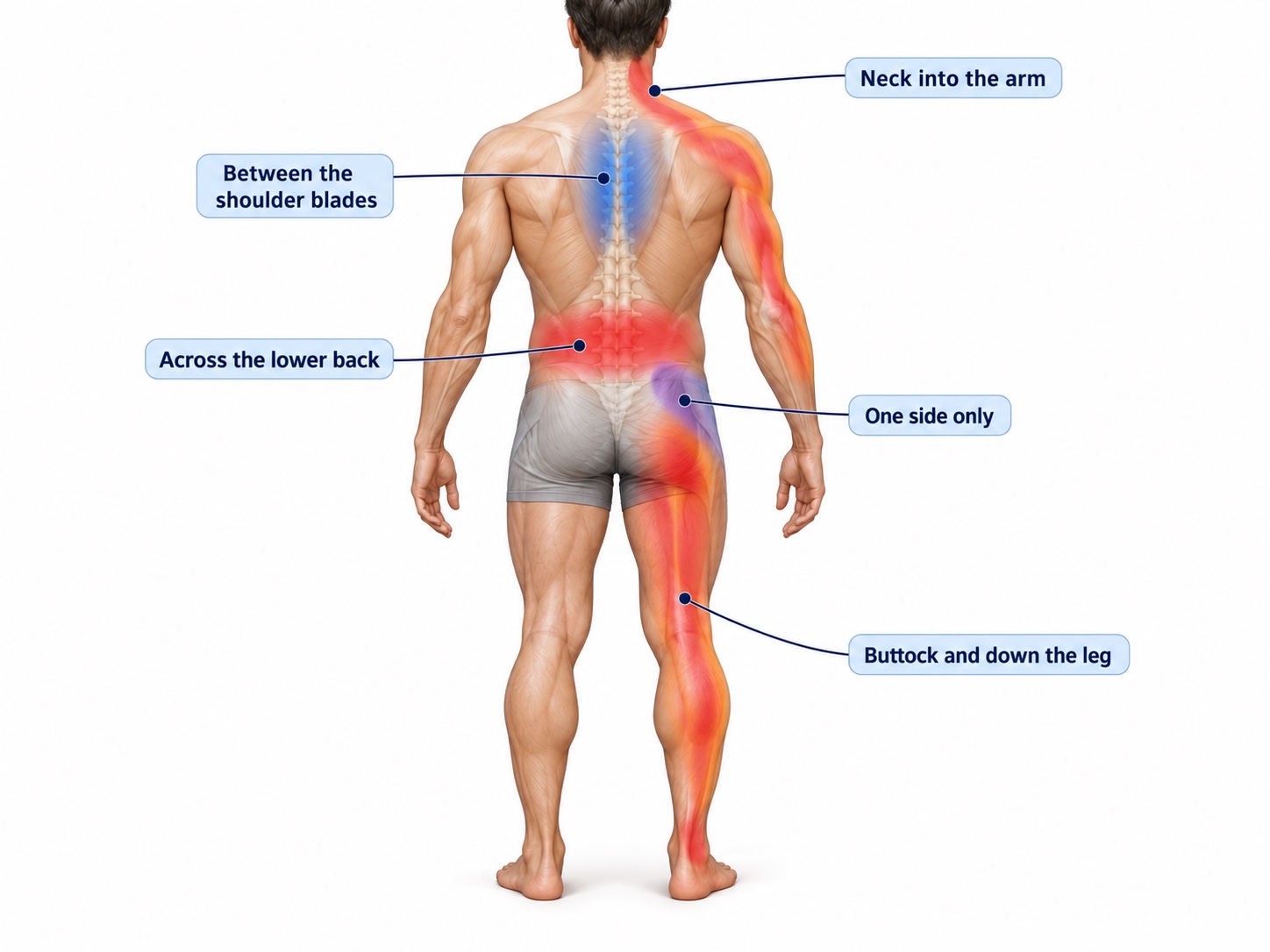
Across the lower back, both sides
This is the commonest presentation by a distance. A broad band of ache low down, often worse after sitting for a long stretch or first thing in the morning, usually easier once you have moved about. It is frequently described as stiffness as much as pain.
This pattern is overwhelmingly mechanical, coming from the muscles, ligaments and joints working slightly harder than they would like. It is also the pattern most likely to settle by itself. The lower back pain page goes through the common triggers in more depth.
Low down, on one side only
Pain fixed stubbornly to one side, often just to the side of the spine itself or over the dimple above the buttock, is a different animal. It can come from a facet joint on that side, or from the sacroiliac joint where the spine meets the pelvis.
A detail I always ask about here is what happens when you arch backwards. Facet joint pain classically worsens when you lean back and eases when you lean forward, which is the opposite of what most people expect pain from a “bad back” to do. Sacroiliac pain often has a particular signature too, being worse when rolling over in bed or getting out of a car.
In the buttock and down the leg
Once pain travels below the knee, the conversation changes. Pain that runs from the buttock down the back of the thigh, past the knee and into the calf or foot is usually nerve pain rather than joint pain, and it has its own name, sciatica. It happens when a nerve root is irritated somewhere along its route.
The counterintuitive part is that many people with genuine sciatica have very little back pain at all. The problem sits in the back, the symptom appears in the leg. I see people who have spent weeks treating a calf strain that was never a calf strain. There is a full explanation on the sciatica page, and it is worth reading if the pain in your leg is louder than the pain in your back.
Leg pain that only appears when you walk
This one deserves singling out because it is so often missed and so often misattributed to simply getting older.
The pattern is specific. You set off walking and feel fine. After a few hundred yards your legs start to ache, feel heavy, or go numb. You stop and sit on a wall, or lean forward on a trolley, and within a couple of minutes it clears entirely. Then you walk again and the same thing happens at roughly the same distance.
The giveaway is that leaning forward helps. People tell me they can manage a whole supermarket shop leaning on the trolley but cannot walk to the end of their own road. Bending forward opens the spinal canal slightly, which relieves pressure on the nerves, and that is what makes the trolley work. This pattern points towards lumbar stenosis, a narrowing of the spinal canal in the lower back, and it is worth getting assessed rather than accepting as inevitable.
In the middle of the back, between the shoulder blades
Pain here is much less common than at the top or bottom of the spine, because the middle section of the back is braced by the rib cage and simply moves less. Most of it is postural or muscular, particularly in people who spend long hours at a desk.
Because it is less common, I take new mid back pain a little more seriously than new lower back pain, particularly if it is constant, wakes you at night, or arrives without any obvious trigger. That is not a reason to panic. It is a reason to get it looked at rather than wait it out.
In the neck, and into the arm
The neck follows the same logic as the lower back, just a level up. Pain confined to the neck and shoulders is usually mechanical. Pain that travels down the arm, with pins and needles or numbness in particular fingers, suggests an irritated nerve root in the neck. The neck pain page covers both.
One specific combination always gets my attention, and it is worth knowing about. Clumsiness in the hands, dropping things, buttons and coins becoming difficult, together with any change in balance or walking. That combination can indicate pressure on the spinal cord itself rather than a single nerve root, and it should be assessed promptly rather than monitored at home.
Question two: what does the pain actually feel like?
The character of the pain narrows things down considerably, and it is the question patients find hardest to answer because nobody has ever asked them to describe it carefully before. These are the four descriptions I hear most.
-
A dull, heavy ache that moves about a bit. Usually muscular or joint related. It tends to be worse with sustained positions, better with gentle movement, and it rarely stays in exactly the same square inch from one day to the next. This is the most reassuring description of the four.
-
A sharp, electric, shooting pain. This is the language of nerves. People describe it as lightning, or like a hot wire. It often fires with a specific trigger such as coughing, sneezing or standing up from a chair, and it frequently travels. Sharp and travelling together usually means a nerve root is being irritated.
-
Burning, tingling, or pins and needles. Also nerve related, but it tells you something slightly different. Where an electric pain suggests a nerve is being mechanically irritated, a persistent burning or numbness suggests it is being compressed or has been irritated for a while. I pay close attention to exactly where the numbness sits, because the map of which nerve supplies which patch of skin is reliable enough to point at the level involved before any scan is taken.
-
Heaviness, giving way, or a feeling of instability. Worth taking seriously, and worth distinguishing from pain. Patients sometimes tell me their back feels like it might “go” if they turn the wrong way, or that they need to brace before standing. That is a different complaint from pain and sometimes points towards spinal instability, where one vertebra moves slightly more on its neighbour than it should.
If you take one thing from this section, let it be the difference between ache and electricity. An ache that stays in your back is a very different problem from a sharp pain that travels down a limb, and they are managed differently from the first appointment onwards.
Question three: how long has it been going on?
Duration changes the advice more than almost anything else, which is why the same symptom can get two completely different answers depending on when you ask.
Under six weeks · Acute
The honest answer is that the most likely outcome is recovery without any intervention. What helps is unglamorous. Keep moving within reason, avoid bed rest beyond a day or two, use simple pain relief so that you can stay active, and be patient. Scans at this stage usually change nothing except your anxiety levels. The exception is the red flag list below, which overrides the clock entirely.
Six to twelve weeks · Subacute
The pain has outstayed its welcome. This is where an assessment becomes genuinely useful, not because something sinister is likely, but because the odds of it settling on its own start to fall and there is now something to gain from knowing exactly what you are dealing with. Most of what helps here is still not surgical. Targeted physiotherapy, and sometimes an injection to settle an inflamed nerve root, do most of the work. The conservative care page sets out what that actually involves.
Beyond twelve weeks · Chronic
Now we are talking about chronic back pain, and the approach shifts. Long standing pain is rarely a simple matter of one damaged structure, and treating it as though it were tends to disappoint everyone. Sleep, deconditioning, fear of movement and the sheer exhaustion of hurting for months all become part of the picture, and all of it needs addressing. I am direct with patients about this, because the worst outcome of the lot is an operation performed on a scan finding that was never causing the pain.
Do not wait on these
Go to A&E the same day, or call 999, if back pain comes with any of the following:
- Numbness around the saddle area, meaning the inner thighs, the groin, or the area you would sit on
- Any new difficulty passing urine, loss of control of the bladder or bowel, or not being able to feel when you need to go
- Weakness in both legs, or weakness in one leg that is getting worse by the day
- Severe back pain after a significant fall or accident
These can indicate cauda equina syndrome, where the bundle of nerves at the base of the spine is compressed. It is rare, but it is a genuine emergency where hours matter for recovery. Nobody will think you wasted their time.
There is a second list that is not an emergency but should not be ignored either. Book a prompt appointment if your back pain comes with unexplained weight loss, fever or night sweats, if you have a history of cancer, if the pain is constant and clearly worse at night rather than with activity, or if you are over fifty with new back pain and no obvious cause. None of these mean something is seriously wrong. They mean the odds have shifted enough to justify a proper look.
What a consultation actually adds
Patients often assume a specialist appointment means a scan and a decision about surgery. In practice it is mostly conversation.
I will spend the first part of any consultation taking a history, which sounds procedural but is where most of the diagnosis comes from. What you were doing when it started, how it has changed, what makes it better, what makes it worse, where exactly it travels, what it stops you doing. The examination that follows is largely about confirming or ruling out what the history has already suggested. Reflexes, power in specific muscle groups, sensation in specific patches of skin, and how you move.
Only then does a scan become useful, and sometimes it does not become useful at all. An MRI is a superb test, but it answers the question “what does this spine look like” and not “why does this person hurt”. Those are different questions. Ordering a scan before you know what you are looking for is how people end up being treated for findings that were never causing their symptoms.
The honest value of a consultation, for most people, is not an operation. It is knowing what the problem is, what it is not, roughly how long it is likely to take, and what the options are if it does not settle. A good proportion of the patients I see need no procedure at all, and leave with a plan and a considerable amount of reassurance. That is a perfectly good outcome.
What I tell my patients
If your back has been hurting for less than six weeks, there is no numbness in the saddle area, no change in bladder or bowel function, no progressive weakness, and the pain is an ache rather than electricity down a limb, then the odds are strongly in your favour. Keep moving, treat the pain so that you can, and give it time. Resist the urge to scan it early.
If it has gone past six weeks, or if it travels below the knee, or if it changes how you walk or what you can feel, that is the point to have it assessed properly rather than waiting to see. Not because it is likely to be serious, but because there is no longer much to gain from waiting and a reasonable amount to gain from knowing.
And if something on this page sounded uncomfortably familiar, particularly in the red flag box, act on it today rather than tomorrow. Backs are forgiving. Nerves are considerably less so.
This article is general information, not personal medical advice. If you are worried about your own symptoms, please speak to your GP or a specialist.
Take the next step
Ready to talk it through?
Speak with Mr. Rath about your diagnosis and treatment options.
Book Appointment